SELF-HONESTY: THE COURAGE TO FACE YOUR OWN TRUTH
4/18/2026

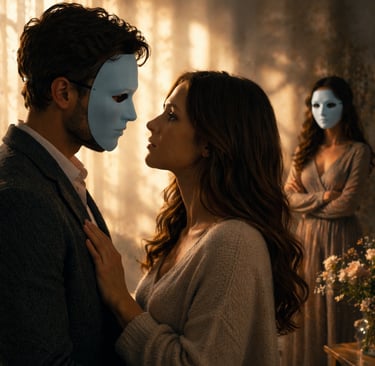
When we avoid truth within ourselves, we unknowingly create suffering in the lives of others.
There is a quiet danger that lives within the human heart—one that does not shout, but whispers… one that does not break suddenly, but slowly erodes what is real.
It is the absence of self-honesty.
At first, it may seem harmless. A hesitation to admit a feeling. A reluctance to face an uncomfortable truth. A decision to “carry on” rather than confront what we already know deep inside. But when a person turns away from truth within themselves, they begin to live a divided life—one that appears real on the outside, but is built on illusion within.
And illusion, no matter how well maintained, always carries a cost.
There was once a young couple who seemed to follow the natural path of love. They met, formed a relationship, and eventually decided to marry. Everything appeared right. Everything looked complete.
But beneath the surface, something was not aligned.
When the young woman introduced her closest friend into their lives, something shifted in the heart of the man. His attention moved. His affection deepened—not toward the woman he was about to marry, but toward her friend.
At that moment, life presented him with a sacred opportunity: to be honest with himself.
He could have paused. He could have acknowledged the truth rising within him. He could have had the courage to speak, to step back, to prevent a life built on something he knew was not real.
But he did not.
Instead, he chose silence.
He moved forward with the wedding. He took vows that his heart could not honour. He created a life that looked committed—but inside, it was divided.
What followed was not an immediate collapse, but something far more subtle and painful: years of quiet betrayal. A hidden emotional bond that continued to grow. A marriage where presence was absent. A wife who gave her love sincerely, yet received indifference, distance, and criticism in return.
She did not know why.
She only felt the absence.
And so she tried harder… not realising she was trying to sustain something that had never been whole from the beginning.
Years passed. Children were born. Life continued outwardly. But the truth remained buried—and in its place grew confusion, emotional pain, and eventually, separation.
By the time the marriage ended, the damage had already been done—not only to the couple, but to the emotional world of those connected to them.
All of this… not because of one moment of wrongdoing, but because of one moment of avoided truth.
Self-honesty is not simply a personal virtue—it is a responsibility.
When we are not honest with ourselves, we do not only deceive our own hearts… we unknowingly involve others in a reality that is not true. We invite them to build trust, to invest love, to make life decisions—based on something we already know is uncertain or misaligned.
And this is where the deepest harm occurs.
Because while truth may hurt in the moment…
illusion wounds over time.
To face truth early requires courage. It may bring discomfort, disappointment, even temporary pain. But it also brings clarity, dignity, and freedom—for ourselves and for others.
To avoid truth, on the other hand, may feel easier in the beginning. It allows us to maintain appearances. It protects us from difficult conversations. It keeps everything “stable” on the surface.
But beneath that surface, something begins to fracture.
A life built without self-honesty becomes a life divided:
· Words that do not match feelings
· Actions that do not reflect intention
· Commitments that the heart cannot sustain
And over time, this division does not remain hidden. It shows itself in distance, in indifference, in quiet dissatisfaction, and in the emotional confusion of those who sense something is wrong but cannot understand why.
The tragedy is not only that truth was avoided…
but that others were unknowingly carried into that avoidance.
Self-honesty begins in stillness.
It is the ability to sit with yourself and ask:
“What is true for me right now?”
Not what is expected.
Not what is convenient.
Not what avoids discomfort.
But what is real.
This practice requires courage, because truth does not always align with what we hoped for. But it is in facing that truth that we prevent deeper suffering later.
Here are gentle ways to live with greater self-honesty:
1. Pause when something feels “off”
When your heart feels uncertain, do not rush forward. That discomfort is not your enemy—it is your guide.
2. Name your feelings truthfully
Even if you do not act immediately, be honest within yourself. “I am unsure.” “I feel drawn elsewhere.” “Something is not right.”
Truth begins with acknowledgment.
3. Do not make permanent decisions from temporary clarity
Marriage, commitments, promises—these should come from a place of inner alignment, not confusion or pressure.
4. Respect the lives of others as deeply as your own
Every decision you make in relationship affects another person’s emotional world. Self-honesty is an act of respect.
5. Choose courage over comfort
A difficult truth spoken early can prevent years of silent suffering.
Closing Reflection
To be honest with yourself is one of the purest forms of integrity.
It is not about perfection. It is not about always knowing the right answer.
It is about having the courage to face what is real—before life forces that truth to surface in more painful ways.
Because in the end, truth does not disappear.
It waits.
And the longer it waits, the more lives it touches when it finally arrives.